The internal voice – the source of human narrative?
In recent research into the way the human brain synthesises speech, it has been discovered that there is a complex sequence of events that takes place to transform thoughts into language and speech. One of the drivers of this research has been to find ways in which communication can be opened with patients suffering from ‘Locked In’ syndrome where due to brain damage or disease they are conscious but cannot move the larynx, mouth or lungs to speak.
By the mid 1990’s the ability to read brain signals had advance considerably from the days of Dr Hans Berger’s invention of the electroencephalograph (EEG), which placed electrodes on the brain to measure the electrical activity of the brain’s neurones firing.
One of the main objectives was to find a way in which a device could be constructed which could instantly translate the electrical signals of our ‘inner voice’ into a sound produced by a speech synthesis device. This approach meant focussing on the signals coming from the brain areas that govern speech.
In 2008 the neuroscientist Philip Kennedy succeeded by focusing in on the face and the specific part of the motor cortex which controls the larynx, mouth and tongue, where you can identify the various muscle signals that are used when a person speaks.
Saying a specific word needs a specific combination of movements with the lips, tongue and lungs pushing the air through a shape in your mouth created by the muscles pulling the mouth into a shape that changes as each component of the word is expressed. Kennedy and Frank Guenther, a neuroscientist at Boston University read these signals in a person with Locked In Syndrome and by implanting deep electrodes in their facial motor cortex, they were able to identify three vowel sounds and feed them into a speech synthesiser. By using this approach Kennedy and Guenthther could sample up to a 100 useful words for this patient over a five year period.
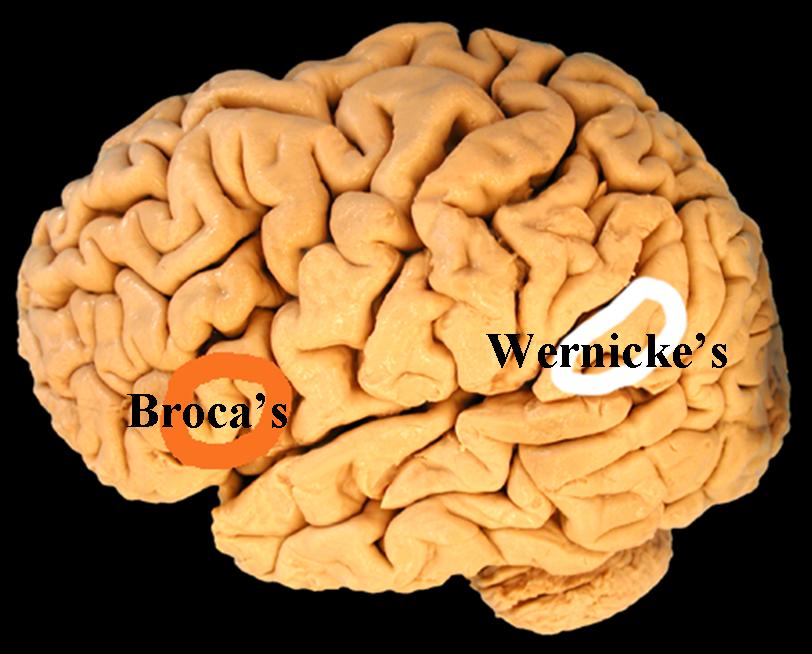
The translation of actual thoughts into language is a complex and mysterious process. It appears that thoughts have to go through two main staging areas before they become an expression of speech. The first area is Wernicke’s area which deals with semantics, ideas which are conceptual rather than linguistics. This includes meaning based around images, smells or emotional memories. The study of patients who through strokes have suffered damage to the Werncike’s area show a loss of semantic associations; words don’t make sense when split from their meaning. Patients have trouble understanding not just what people are saying to them, but what they are also thinking.
The second staging area is Broca’s area, which it is thought is the brain’s speech synthesis centre. It is here that the semantic meanings are translated into phonetics and then word component form. These signals are then assembled into sets of meaningful words in the right order to go to the motor cortex for the mouth, larynx and tongue to express as speech.
As part of any individual experience of consciousness there is clearly an internal voice that operates inside our minds. We hear this voice expressing our thoughts in words and sentences as we experience the world in real time and interact with it.
As you hear this inner voice two things are happening, you hear yourself producing language in Wernick’es area as you construct it in Broca’s area.
From the mechanical perspective there is still the need to imagine a sort of mental language ‘Rosetta stone’, which enables the quarter of a million distinct words in the English language to be instantly recognised and processed within this internal voice/speech process. One possible candidate for this process are phonemes, which are the most basic building blocks of language and are the most likely evidence of the early evolutionary signs of language development in early hominids.
The English language had about 40 phonemes and every word contains some subset of theses building block phonemes sounds, such as ‘kuh’ as in School or ‘sh’ as in shy. These phonemes effectively allow the brain to decode every word on the instant of hearing it.
Research is now looking at how to link the inner voice system with speech synthesis devices and that other holy grail long described in science fiction, of controlling devices and machines by thought alone or rather with instruction generated by the ‘inner voice’.
From the perspective of the development of human consciousness there seems to be a very clear link between the appearance of language and the ability to perceive the world through the reflective inner human mind. The birth of language seems to have come during the Palaeolithic era and although difficult to predict accurately, it seems that language as we would recognise it developed around 100,000 years ago and language and consciousness seem to be inextricably linked.
Before language or speech, human consciousness was similar to animal consciousness although probably more refined. In animals, an organism sees subject and object as largely the same. Information flow through the animal consciousness is episodic, mainly driven by external stimulus and reacted to in a largely instinctive way based on an inherited and set of genetic predispositions. A primary default setting for consciousness is indifference and things only become worthy of attention when they change, presenting either an opportunity or a threat. The perception of events is largely discontinuous and lacks any form of narrative which creates causality and the internal story-telling process, which turns expectation into a concrete real world view.
Cognitive psychology shows that most conscious experience is the function of memory, with sensation often the trigger. Experience is almost always the containment of perception within memory. The conscious self takes the role of the architect of perceived continuity, taking the phenomena of sensation and building a story around them. The ‘story’ is mostly built on expectations, beliefs and memory. The ‘self’ produces the internal narrative and the sense of being in time. The theory of mind is the core theory that defines how human intelligence allows humans to see others as separate from themselves yet able to make predictions about behaviour and outcomes which rely on having an internal mental model of the real world and the internal narrative to make predictions about what are the consequences of an individual’s actions.
Moving this concept on, language allows the sharing of this way of experiencing the world and one of the core functions of language is that it is fundamentally a shared process, speech is designed to link individuals in an interaction, it therefore follows that there is a deep link between the internal narrative, its shape and flow and deep links with other humans. The sharing of language is as fundamental as language itself; it is almost a function of language that is inextricably linked to the sharing and the interactive process.
The implications are interesting because once the flow of information through the organism is no longer constrained by the immediate needs of the individual organism, the nature of it’s unique internal world view automatically becomes a shared and communal view of the world. The organism now becomes one of a community of organisms with a unique relationship that is a million miles away from the natural herds, swarms or flocks, typical of other animal social structures.
This sees a collective intelligence develop which effectively ‘fast tracks’ the homo sapiens on the evolutionary race, through to much higher intellectual capabilities to hunt, protect and survive. This ability marks Homo Sapiens out from the other competing hominids, such as Neanderthals and Homo Erectus that lived at the same time as early homo sapiens. It is Sapiens that developed language and speech most effectively and ended up seeing the other hominids become extinct.
Language generated collective knowing and by connecting individual intelligence, created a powerful capability within human groups to dominate the environment they lived in.
The ‘shared experience’ of life can be seen as the driver for the concept of storytelling as it is only a tiny step removed from the internal narrative. Individuals shared a collective narrative, which enshrines the collective experience of the world. The ‘myth’ and ‘the story’ are more closely allied to the natural architecture of the human brain, the functions of language and the feature of the internal voice.
Any story is like an extension of shared thought processes and using language, effectively links human brains in a fundamental and natural network. Story-telling is almost in the same evolutionary category as eating and breathing, it is fundamental and clearly hints at considerable evolutionary advantages that ensured its survival and made it such a feature of modern human’s brains.
Speech and language create problems as well as opportunities and the ability to share experience in human communities also creates considerable stress far above the stress seen in animal pack behaviour or pecking orders. Competition and ranking are far more complex and therefore easier to get wrong or misinterpret. Human society is a stressful one, where the dangers from your fellow humans are almost on a par with natural threats from the outside world. A creature with highly complex behaviour needs very complex emotional understanding and intellectual capability to interpret and manage any interactions with other humans. We can read micro muscle movement in face to give us information about another’s emotional state and intentions. We need to know with each encounter whether this person is an ally, mate or threat.
This puts a greater emphasis on the usefulness of myth and storytelling to help codify patterns of behaviour that can ease the stress of dealing with other humans and make human communities more manageable for the individuals.
We now see how ritual and myth have become intrinsic features of the human brain and its structure. Ritual is the performance of myths that binds the individual and the specific to the universal and the archetypal. The brain’s shared inner voice is the primary mechanic in which human being experience their life in the world and with others.
All the great mythical stories and ‘mythical magic’ takes the power of the word as it primary currency. Words are all powerful and are the starting point of belief systems, “In the beginning was the Word, and the Word was with God, and the Word was God ” and this extends into the mechanics of sympathetic and imitative magic ritual where naming forces outside our control helps to exert influence over their behaviour.
Within the development of religion and art we can see how the inner voice is the foundation of artistic reflection and thinking. It is arguable about what evolutionary benefits art brings to the human organism but it is ubiquitous among human societies and cultures and shows large investments of time and energy by individuals for uncertain benefits.
Somehow there appears to be a link between the shared inner voice through language and speech, with human communities and the expression of art as a shared process among groups of humans, where the artist and the viewer are linked in ‘mind’.
Mythological material and experience seems to be genuinely part of the fundamental software of the human brain and part of the underlying architecture of human intelligence and behaviour, which is why its power and relevance to modern human behaviour and thinking is utterly valid and primarily powerful.
 Andrew Hillary